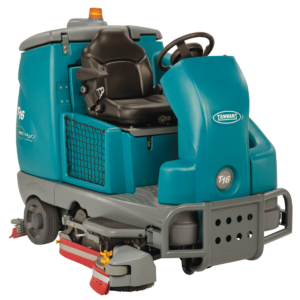
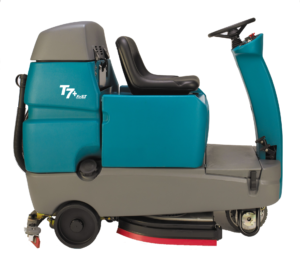
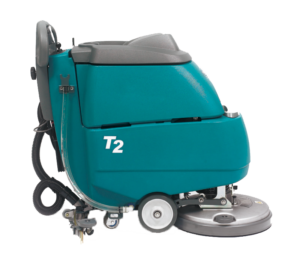
Pedestrian Scrubber Dryer Options

Pedestrian Scrubber Dryers: A Complete Guide
What Is a Pedestrian Scrubber Dryer?
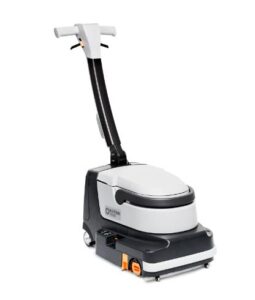
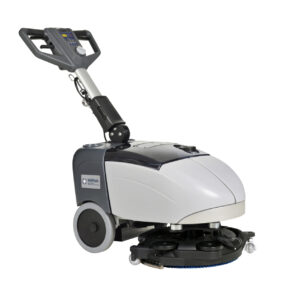
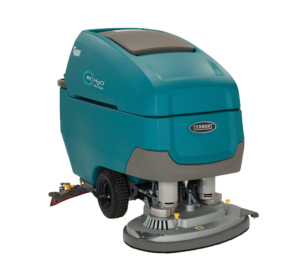
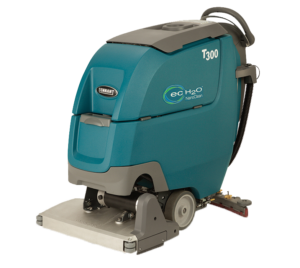
A pedestrian scrubber dryer (also called a walk-behind model) is a battery or cord-powered floor cleaning machine that automatically applies cleaning solution, scrubs with rotating brushes or pads, and then vacuums up dirty water, all in one pass. Compared with mopping, these machines save time, reduce manual effort, and deliver more consistent, hygienic results.
What to look for when considering a pedestrian scrubber dryer?
- Cleaning Path & Productivity – A wider cleaning path means more floor covered per pass. Small units (400–600 mm) are ideal for tight spaces; larger ones (700 mm+) suit open areas like retail aisles. Productivity is usually expressed in m²/hour and correlates with width and travel speed.
- Tank Capacities – The solution tank holds clean water/cleaning fluid. The recovery tank collects dirty water. Larger tanks reduce refill/empty cycles — vital for big jobs.
- Brush Type & Down – Pressure Disk or cylindrical brushes affect soil removal and debris pickup. Down pressure influences how hard the brush presses; higher pressure can improve cleaning on textured or rough floors.
- Battery & Run Time – Battery capacity and chemistry determine how long the machine runs between charges. For long shifts, longer run time is essential.
- Noise Levels – Quieter machines (below ~65 dBA) let you clean during daytime in noise-sensitive environments like hospitals or offices.
- Manoeuvrability & Ergonomics – Look for easy steering, comfortable operator handles, and minimal training requirements.
- Maintenance & Support – Easy access to service points, clear controls, and strong aftermarket support, especially for parts and service, can reduce downtime and total ownership cost.
Hire vs Purchase: Pros & Cons
Hiring
- Lower short-term cost, ideal for one-off jobs or seasonal demand.
- Access to higher-end or specialised machines without CAPEX.
- No maintenance or storage commitment.
- Over time, repeated hire may cost more than buying.
- Availability may vary.
Purchasing
- Higher upfront cost.
- Staff become familiar with the same model, reducing training time.
- You must store, maintain, and eventually replace the machine.
- Cost-effective long term if used regularly however,
- Depreciation and parts costs should be factored in.
Model Specifications & Comparisons
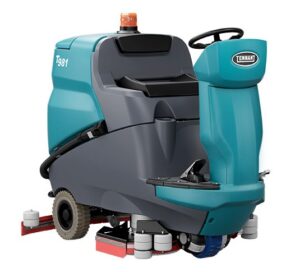
TENNANT Pedestrian Scrubber Dryers
(The T-series are generally battery models designed for commercial cleaning.)
| Model | Cleaning Width | Tank (L) | Ave Run Time | Best Use |
|---|---|---|---|---|
| T600 | 700–900 mm | 121/140 | 6.9 h | Large open areas; warehouses, supermarkets |
| T500 | 650–800 mm | 85/102 | 5.9 h | Mid-size facilities, retail aisles |
| T300 | 430–600 mm | 42/53 | 3.8 h | Smaller spaces, frequent touch-ups |
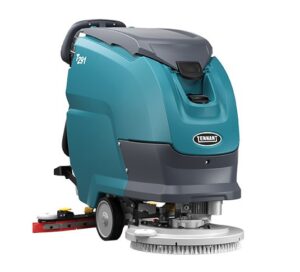
| T291 | 550/600/700 mm | 50/50 | 2.5–3.5 h | Tight spaces, busy floors |
| T391 | 600/700 mm | 70/70 | 3.5 h | Mid-size retail, education, healthcare |
| T191 | ~455 mm | 28/30 | 2.5 h (battery) | Very small areas & spot cleaning |
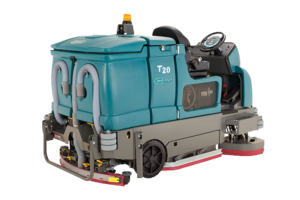
| T2 | ~430 mm | ~26/36 | Variable | Compact daily cleaning |
| CS5 Compact | ~400–500 mm | Small | — | Ultra-compact light duty (e.g., reception areas) |
Typical strengths of Tennant models:
- Wide range of sizes, from micro (T191, T2) to larger walk-behinds (T600).
- Good ergonomic design and service networks.
- Often offer optional advanced cleaning technologies on larger models (e.g., chemical-free cleaning). Note: ec-H2O NanoClean / FaST options vary by region.
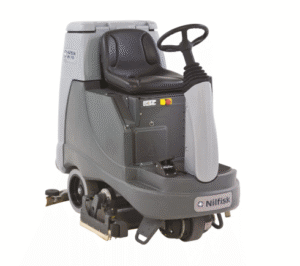
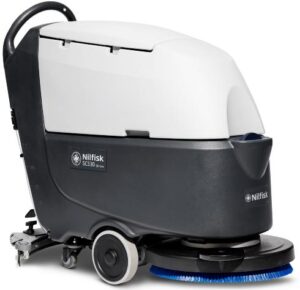
Nilfisk Pedestrian Scrubber Dryers
Nilfisk’s range covers compact entry-level to heavy-duty medium walkers.
| Model | Cleaning Width | Tank (L) | Ave Productivity (m²/h) | Best Use |
|---|---|---|---|---|
| SC100 | Small | 6/6 | 300 m²/h | Very light & tight spaces |
| Nilfisk SC250 | 340 mm | 32/32 | 680 m²/h | Compact retail/office |
| Nilfisk SC351 | 370 mm | 11/11 | 890 m²/h | Small spaces; forward/back scrub |
| Nilfisk SC430 53B | 530 mm | 40/40 | 1272 m²/h | Everyday commercial cleaning |
| SC450 | 530 mm | 40–45 | 1272 m²/h | Budget mid-size cleaning |
| SC500 | 530 mm | 45/45 | 1590 m²/h | Mid commercial applications |
| SC530 / SC530 GO | 530 mm | 61/61 | 1272–1431 m²/h | Larger duty mid-range cleaning |
| BA/CA 551/611 | 510–610 mm | 55/55 | 1320–1460 m²/h | Heavy general use |
| BA 651/751 | 660–860 mm | 85/85 | 2200–2895 m²/h | High-productivity tasks |
| SC800 | ~710 mm | 95/95 | 2470 m²/h | Large areas with heavy soils |
Typical strengths of Nilfisk models:
- Broad spectrum — from very small machines (SC100) to large heavy-duty walk-behinds (SC800).
- Many models are designed for ease of use and serviceability.
- Forward and backward scrubbing available on smaller units like SC351.
Side-by-Side Practical Comparison
Size & Application
- Smallest units (T191, SC100, SC250) — best for offices, reception areas, or tight corridors.
- Mid range (T291, T300, SC430, SC500, SC530) — versatile for retail, schools, healthcare.
- Large units (T500/T600, BA/CA 651, SC800) — suited to big spaces like warehouses and supermarkets.
Ease of Use
- Nilfisk SC series often emphasise simplicity (OneTouch controls on many units) and good maintenance access.
- Tennant models typically include ergonomic controls and optional technologies that optimise cleaning performance (e.g., ECO modes).
Productivity & Capacity
- Larger tank & wider cleaning width = more productivity but less nimble.
- Choose larger machines if you clean many square metres daily; choose smaller units for segmented spaces or frequent spot cleaning.
Tips for Choosing the Right Machine
- Consider operator skill — simple controls and automatic features help reduce training time.
- Match machine size to area size and layout.
- Plan for maintenance and consumables (brushes, squeegees, batteries).
- Assess total cost — purchase makes sense for regular use; hire can be right for occasional jobs.
Summary Recommendations
- For small, confined spaces: look at T191, T2, SC100, SC250, SC351.
- For general commercial areas: T300/T291/T391 or SC430/SC500/SC530 balance productivity and size.
- For larger or heavy-duty cleaning: T500/T600, BA/CA 651/751, SC800 deliver more power and capacity.