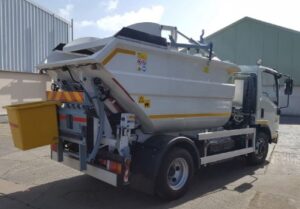
Waste Collection Vehicles
Our refuse collection vehicles are ideal for domestic and commercial waste collections and suitable for food waste and other mixed recyclables. With a wide range of premium models to choose from, you can count on us for RCV hire
Refuse waste trucks form the backbone of any waste management fleet. From compact food waste collectors to heavy-duty front loaders, each type of refuse vehicle serves a specific purpose. Choosing the right vehicle means balancing route size, waste type, access limitations, and environmental targets.
Find out about the main types of refuse collection vehicles (RCVs) and see our options of the leading solutions—including the Farid Hillend range and the Dennis Eagle Olympus Mini.
Main Types of Waste Collection Vehicles
1. Rear Loader Refuse Trucks
Most common design in domestic and commercial waste collection.
- How it works: Waste is manually or mechanically loaded into the rear. A hydraulic compaction mechanism compresses the load to maximize payload.
- Best for: Mixed household waste, general rubbish, and commercial contracts.
Pros:
- Compatible with bin lifts
- High compaction ratio
- Easy to operate and service
Cons:
- Slower loading in dense urban areas
- Rear access needed for operation
2. Side Loader Refuse Trucks
These vehicles use an automated side arm to pick up bins, reducing the need for operatives.
- Best for: Residential curbside collection routes with standardized bin types.
Pros:
- One-person operation
- Fast and efficient
Cons:
- Requires consistent bin placement
- Not ideal for dense cities with irregular parking
3. Front Loader Refuse Trucks
Primarily used in commercial and industrial settings, these trucks lift large containers over the cab and dump them into the top of the body.
- Best for: Industrial waste, retail parks, factories
Pros:
- Handles large volumes quickly
- Ideal for scheduled commercial pickups
Cons:
- Large turning circle
- Requires front clearance space
4. Split-Body or Dual-Compartment RCVs
Used to collect multiple waste streams simultaneously, e.g., recyclables and general waste.
- Best for: Municipal contracts with multi-stream requirements
Pros:
- Reduces fleet size
- Efficient for mixed-material routes
Cons:
- Higher upfront cost
- Requires driver/loader training
5. Food Waste Trucks
Built specifically to carry wet organic waste, often with stainless-steel sealed bodies and wash-down systems.
Pros:
- Leak-proof design
- Odour and hygiene controlled
- Compact and maneuverable options available
Cons:
- Lower volume than standard RCVs
- Purpose-built for a single waste stream
Featured Models in the Food Waste Category
🔹 Farid Hillend Micro L
- GVW: 7.5 t
- Body Volume: 5.5 m³
- Payload: Up to 3.5 t
- Best For: Urban centres, tight access streets
- Benefits: Leak-proof steel body, 3:1 compaction, comb-lift bins
🔹 Farid MiniMatic 8
- GVW: 7.5 t
- Body Volume: 8 m³
- Compaction: Up to 4:1
- Best For: High-frequency food collections in hospitality zones
- Benefits: Stainless interior, compact, ultra-hygienic
🔹 Farid Micro XHD
- GVW: 12 t
- Capacity: 8 m³
- Compaction: 3.5:1
- Best For: Suburban rounds, heavier food waste loads
- Benefits: Twin-lift bins, up to 6 t payload, more powerful compaction
🔹 Dennis Eagle Olympus Mini
- GVW: 12 t
- Body Volume: 8 m³
- Compaction ratio: 6:1
- Best For: Multi-stream municipal waste
- Benefits: Rear loader design, compact size, flexible configuration
Specification Comparison Table
| Feature | Farid Micro L | MiniMatic 8 | Micro XHD | Olympus Mini |
|---|---|---|---|---|
| Chassis (GVW) | 7.5 t | 7.5 t | 12 t | 12 t |
| Capacity | 5.5 m³ | 8 m³ | 7m³ | 8 m³ |
| Payload | Up to 3.5 t | Up to 2.5 t | Up to 6 t | 3–5 t (est.) |
| Compaction Ratio | 3:1 | 4:1 | 3:1 | 6:1 |
| Bin Lift | 120–1,100 L | 120/240 L | Twin 320 L | 120/240 L |
| Use Case | Urban narrow | Hospitality | Mixed urban | Mixed municipal |
Where Are Waste Collection Vehicles Typically Used?
| Vehicle Type | Best Environment |
|---|---|
| Rear Loader | Urban & suburban domestic routes |
| Side Loader | Standardised bin neighbourhoods |
| Front Loader | Industrial parks, factories |
| Split Body RCV | Mixed collection municipal contracts |
| Food Waste Vehicle | Restaurants, housing estates, schools |
Choosing the Right Waste Collection Vehicle: Key Considerations
When selecting your refuse truck, ask the following:
- What type of waste is being collected?
Food, general, recyclables, or commercial? - How often will collections occur?
High-frequency routes demand better compaction and payload. - Are there narrow streets or low-emission zones?
Opt for compact models or electric alternatives. - What bin sizes need to be lifted?
From 120L to 1,100L, compatibility matters. - Is hygiene a concern?
Sealed bodies, wash-down systems, and stainless interiors are essential for food waste.
Support, Service & Customisation
Dawsongroup offer full service with a 24/7 support should anything happen whilst you are hiring vehicles from us. If you want to purchase any waste collection vehicles we also offer financing too. Please contact us for any requirements you have as we can advise on the best vehicle for your situation or project.